Showing posts with label The al-Sabah Collection. Show all posts

Wednesday, March 23, 2011

Amricani Cultural Centre: Behind-the-Scenes

The past couple of months, before the preview for the new Amricani Cultural Centre, have been hectic. We had the preview on February 24th, 25th, and the 26th for our VIP guests and an Open House on March 10th for DAI members. If you follow DAI’s Facebook page, you would have already seen photos from those nights (here and here). 


We were all working long hours until the last minute trying to get everything done on time. Everyone was working together in the office and at the construction site on everything from brochures, booklets, posters, lighting, exhibition text, captions, translating, invitations, installation, and the list goes on. 

While putting all our efforts in the completion of the new cultural centre, the office had to continue organizing the Cultural Season and focus on the ongoing international exhibition (currently al-Fann in Vienna).

Since most of my art history education was European art, and The al-Sabah Collection is art from the Islamic world, I had to do some studying for the exhibition and help prepare myself and my co-workers to be tour guides for the opening. I was also involved with assisting our exhibition designer and graphic designer in preparing, printing and installing the exhibition’s wall panels and captions.


The Amricani Cultural Centre has two exhibitions. One is permanent and the other is in the temporary gallery spaces. The exhibition I was involved with is the temporary exhibition entitled: Treasury of the World: Jewelled Arts of India in the Age of the Mughals. You might have read about it—if not, let it be something you discover when you visit the exhibition after the official opening.


Working on this exhibition was so exciting. I had to visit the site several times as we installed the wall panels. When the installation of the jeweled objects had to start, no one was allowed in the space for security. One of the days during installation I was able to enter the exhibition space and was just so overwhelmed. The diamonds, emeralds and rubies just lit the entire space and it was breathtaking. I have looked through the catalogue of this exhibition and marveled at the objects a hundred times! But when you see them in front of you, it is something completely different. People who had the chance to see them so far have been amazed and impressed by their beauty. I really can’t wait for the opening so everyone can visit and see these magnificent jeweled objects that have travelled the world and are finally exhibited in Kuwait for the first time.


All fuzzy images taken by iPhone. 

Tuesday, February 1, 2011

Jewelled Dagger and Scabbard

Dagger and Scabbard
The al-Sabah Collection, LNS 25 J


One of the finest and frequently published objects from the al-Sabah Collection is this Indian dagger. This object from Mughal India dates from 1615-1620.

Weapons in the Mughal court were designed as a way to demonstrate the wealth and importance of its owner. The weapons, such as this dagger, were also considered symbols of authority and honor. They were often given as imperial gifts to persons of high rank.

The sheaths of the weapons were usually made of leather or velvet, but the most important daggers were set with hundreds of precious stones. The Mughal rulers were very fond of gem-set weapons.

This dagger and scabbard from the al-Sabah Collection is magnificently set with over 2,000 stones; consisting of rubies, emeralds, and diamonds among others. It may well be the most extravagantly luxurious dagger ever produced.  


Source:
Information provided by Treasury of the World: Jewelled Arts of India in the Age of the Mughals, Exhibition Master Pack, December 2008. 

Monday, January 3, 2011

LNS 193 W a


The 13th and 14th century was the fall of the Muslim rule in Spain. The Nasrid kingdom in Spain was the last Islamic kingdom in Western Europe.

This door panel is from the late 14th century. It is 143 cm high and 95.5 cm wide. The interlace design of this door, with its eight-pointed stars and the straight borders forming square panels, is typical of the geometry of Islamic Spain.

This object is currently exhibited in “al-Fann: Art from the Islamic Civilization” in Palazzo Reale, Milan until 30th January, 2011. 

Sunday, December 19, 2010

Take Your Pick: The al-Sabah Collection

The al-Sabah Collection has over 22,000 objects from the Islamic world. Dar al-Athar al-Islamiyyah's website has provided a selection of images of the objects. They are divided into nine categories:

1. Arts of the Book
2. Ceramics
3. Glass
4. Ivory and Wood
5. Jewelery and Jeweled objects
6. Metalwork
7. Numismatics 
8. Rugs and Textiles
9. Stone and Stucco 

I want you to take your pick from the collection and tell me what object interests you and would want to know more about. I will try my best to write up a post dedicated to the object you picked! 

This will make it a fun way for you to discover the objects and learn how vast and comprehensive The al-Sabah Collection of Islamic art is.

Just leave a comment with the number of the object: LNS number(s) letter(s).

Thursday, December 2, 2010

Cultural Season 16: Ivory

This Cultural Season's theme is dedicated to ivory from Islamic lands. The brochure for CS16 has images of several ivory pieces from The al-Sabah Collection.  

Ivory was considered a very valuable and luxurious commodity. Early craftsmen mostly used elephant ivory from East Africa.

If you have a copy of CS16’s brochure, have you wondered what the ivory object on the cover was?


This ivory piece is part of a sword hilt—the grip. It dates to the 14th century from Spain. It is elephant ivory and is carved and decorated with inscriptions and arabesques. Throughout the Muslim world, there was a unity in style of Islamic ivory work; from Spain and Sicily in Europe, to the Near East. Geometry and perfect symmetry were important elements. This is evident in the vegetal designs and organic patterns in this particular object [1].
Images: [1]
This sword grip is hollow and the ornamented section is thicker than the rest of the object. The sizes of ivory objects were limited because of the nature of this material. Judging from the cover image you wouldn’t be able to guess the size of this ivory piece. But this sword grip is 10.00 cm in length, and the width is 4.00 cm. 

Images: [2] An example of another sword with an ivory hilt; also from The al-Sabah Collection.

Even after the fall of the Arab rule in Cordoba, carved ivory remained popular in Spain to the 14th century.  That period of Arab rule had a great influence on craft traditions in that region.


Sources:
-Dar al-Athar al-Islamiyyah's Cultural Season 16 Brochure.
-The al-Sabah Collection's Database. 
[1] "Ivory: A History and Collector's Guide", (London: Thames and Hudson Ltd., 1987), 190. 

Images: 
[1] LNS 20 I from The al-Sabah Collection, carved elephant ivory grip from the hilt of a sword with pious inscriptions. probably Granada, Spain, 8th century AH/14th century AD.  
[2] LNS 37 I from The al-Sabah Collection, carved from walrus ivory; inlaid with gold. length 110 mm; width 39 mm. probably Deccan, Bijapur, dated AH 1044/AD 1634. 

Sunday, November 28, 2010

Bejeweled Turbans

The great Mughals of India decorated their bodies with jewellery from head to toe. The only missing piece was a crown, which was something the dynasty had in common with most other Muslim rulers [1]. The common form of headwear for men was the turban. It is usually flat but the shape changes according to each period. Turbans worn by princes and rulers had luxurious ornaments [2]. 

The original tradition of wearing feathers as a symbol of power goes back to the Mughal's ancestor Timur. The feather on the turban was usually slightly curved because of the weight of an attached stone or pearl [3]. By the time of the early Mughal rulers, there was a new addition to the long curved feathers. Decorative strands of pearls would be hung around the turban and they would be held in place by a fastening or form of turban ornament called a sarpech.

Images :[1]
The sarpech came in many shapes and forms. Ones that are made of precious stones, in a way acknowledged the legitimacy of a ruler; because precious stones were reserved to be worn only by rulers and noblemen. The painting below shows Jahangir handing a sarpech to Prince Khurram--as a sign of recognition.

Images: [2]
The jigha was a form of a turban ornament that was made of bejeweled gold. To evoke the traditional form of a curved feather worn by their ancestor Timur, the shape of the feather was maintained in the jigha [3].This form of turban ornament became very popular during Jahangir and Shah Jahan’s reign [2].

Images: [4]
This magnificent emerald set jigha, dated to the 2nd half of the 17th century AD, is part of The al-Sabah Collection. It was made using the ajour setting. What distinguishes the ajour setting is the way in which large precious stones are set without backings, creating an effect of transmitted light. The way it allows the light to flow through it creates a spectacular effect that recalls stained-glass windows [4]

Perhaps the absence of crowns led the Mughals to increase the imperial look of their turbans. Turban ornaments were taken to a new level of eye-catching display and it only kept growing over the following centuries [3].

The al-Sabah Collection is in possession of several jeweled turban ornaments. This particular piece has been singled out because of its appearance on several exhibition posters and publications. 


Sources:
[1] Manuel Keene with Salam Kaoukji, "Treasury of the World: Jewelled Arts of India in the Age of the Mughals," (London: Thames & Hudson Ltd, 2001), 25. 
[2] Annemarie Schimmel, "History, Art and Culture," The Empire of the Great Mughals, (London: REAKTON BOOKS LTD, 2004), 171 and 176. 
[3] Susan Stronge, "Treasury of the World" in Jewels Without Crowns: Mughal Gems in Miniatures, By Lucien de Guise (Malaysia: IAMM Publication, 2010), 95. 
[4] Information provided by Treasury of the World: Jewelled Arts of India in the Age of the Mughals, Exhibition Master Pack, December 2008. 

Images:
[1] (detail of painting) Farrukh Siyar. Circa 1712-1719. Reproduced by permission of the British Library. Islamic Arts Museum Malaysia Catalogue: Susan Stronge, "Treasury of the World" in Jewels Without Crowns: Mughal Gems in Miniatures, By Lucien de Guise (Malaysia: IAMM Publication, 2010).
[2] Painting of Jahangir Presenting Prince Khurram with a Turban Ornament, by Payag, circa 1640, The Royal Collection Her Majesty Queen Elizabeth II. Islamic Arts Museum Malaysia Catalogue: Susan Stronge, "Treasury of the World" in Jewels Without Crowns: Mughal Gems in Miniatures, By Lucien de Guise (Malaysia: IAMM Publication, 2010).
[3] LNS 1767 J in The al-Sabah Collection. Gold turban ornament worked in kundan technique and set with emeralds and diamonds, the reverse with champleve and overpainted enamel. North Indian or Deccan, 2nd half of 11th century AH/ 2nd half of 17th century AD. 17.4 cm high; 5.25 cm wide. 

Thursday, November 25, 2010

Object Conservation at DAI

Dar al-Athar al-Islamiyyah’s own Sophie Budden, head of the Conservation team, was the presenter on Wednesday. Sophie’s very informative lecture was accompanied by a selection of photographs showing the activities of Conservation at DAI.


Having recently started work at DAI, I haven’t yet understood the amount of effort and time that is needed to look after a large number of antique objects as substantial as The al-Sabah Collection.

With 22,619 objects currently in the collection, it is crucial that the objects are in safe care for long term storage. One of the most important aspects is that the conservators are able to maintain and control the environmental conditions. Different kinds of objects have to be separated into different storage facilities so the humidity can be controlled with either humidifiers or dehumidifiers.


The conservators try to protect the objects from any form of harm, but sometimes life brings unexpected misfortune. In 2008, The al-Sabah Collection had to deal with some unwanted visitors—a moth infestation. Unfortunately, some of the objects were damaged. But before any further damage would be done, the conservators were able to get rid of the moths. What they had to do was wrap all the textiles (which the moths feasted on) and place them in a plastic tent outside in the heat. The tent’s temperature would rapidly increase to 180 degrees! And that extreme temperature killed the moths. So you have to understand how cautious a conversation team has to be when looking after precious objects. One open window or door can bring another moth attack.


The above picture was taken by one of the conservators showing a damaged textile (left)—and  as sad as it is that the textile was slightly damaged, leave it to a conservator with an aesthetic eye to appreciate the beauty of a tiny moth cocoon (right) made up of ancient fibers from the carpet!

Most of the Conservation department’s time consists of cleaning and taking care of the objects; and with 22,619 objects in The al-Sabah Collection keeping record of everything is extremely important. DAI has its own customized database. In this database, everything is recorded about each object. You would find a picture of it, the name, code, description, condition, as well as other information such as its suitability for travelling.

The pieces in The al-Sabah Collection are constantly on loan to museums all over world—from Los Angeles, to St. Petersburg, to Kuala Lumpur. Sophie began to discuss the difficulties of assembling objects for traveling exhibitions such as Treasury of the World and DAI’s most recent exhibition al-Fann. An enormous effort is needed by everyone to display objects carefully. Many carpets from the al-Fann exhibition required 25 people to install!


The objects have to be repeatedly inspected to see if they are fit for not only travelling to one destination, but to be part of a touring exhibition. It is important to know if the object will be able to withstand going to different countries with different climates.

Sophie also showed us how they were able to fix some objects that were destroyed during the Iraqi invasion. As well as showing us photographs of objects before and after cleaning.


    12th century dish destroyed then fixed after the Iraqi invasion.


The photos above show a dish that was restored before it became part of The al-Sabah Collection (top).  Manual Keene (The al-Sabah Collection’s curator) noticed that the design didn’t make sense and for a dish of this style the inscription would have gone all around the rim. The two images (below) show the dish, with the help of DAI's team, being fixed and now the design began to make more sense. There is more information about the discovery of this mistake and the restoration of ceramics similar to this one in the book Ceramics From Islamic Lands "Kuwait National Museum and The al-Sabah Collection".

    Cleaning objects: a photograph showing the before and after of a 7th 
    century silver lion.

The objects have to be carefully cleaned under a microscope with a small scalpel and it takes a month to 6 weeks for one piece. Sophie announced exciting news that DAI will obtain a laser cleaner this coming year. The laser cleaner was only recently available for art and now it will make the process of cleaning much easier. They will be able to clean some objects that couldn’t be cleaned using a microscope and scalpel. Now there will be no risk of damage to the objects and it will cut down working hours by 70 to 80 percent!

The Conservation team is also responsible for testing, pigment identification, wood identification and always gaining further knowledge of each object. The analysis of an object without causing it any harm can be a difficult task. In addition to the laser cleaner, DAI will receive another new machine that will make it easier to analyze the objects.


Sophie’s lecture was extremely informative and interesting. It was very exciting to have the opportunity to see what goes on behind the scenes, and to understand the amount of work required by DAI’s Conservation team to care for The al-Sabah Collection.


Fortunately, for those of you who were not able to attend the lecture, Sophie provided us with a copy of the slideshow where you can view below!


Thursday, November 11, 2010

Peacock Throne

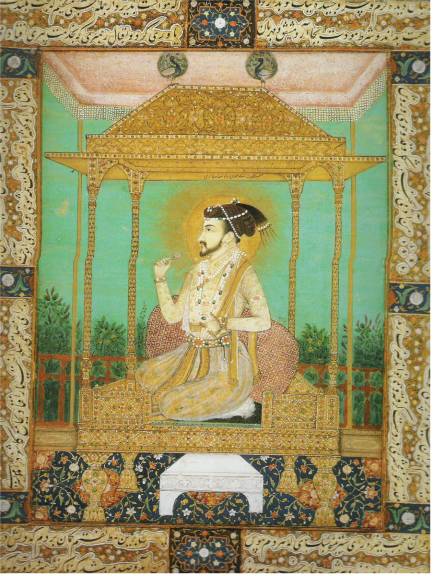
The Mughal Empire in India was the richest Islamic dynasty of its time [1]. Shah Jahan, the fourth Mughal emperor (ruled 1628-58), had the most luxurious court of all his predecessors and successors. (He is the Mughal emperor behind the construction of the magnificent Taj Mahal!) Mughal dynasty was known for its rich collection of precious stones. Emperors of that time decorated the walls of their palaces as well as their bodies with rubies, diamonds, and emeralds [2].

A symbol of the grandeur of the Mughal court is undoubtedly the Peacock Throne, which was commissioned by the emperor Shah Jahan. The "jeweled throne" was made entirely of gold and was covered with precious stones [3]. The exquisite stones were selected by Shah Jahan himself from the Mughal treasury. After seven years, the Peacock Throne was complete. A prominent feature from the Peacock Throne was an engraved gem stone; a spinel [4].

    Images: [1]

Spinels are a kind of precious stone and they were highly valued at the Mughal treasury. The specific inscribed spinel in question was given to Jahangir (ruled 1605-27), Shah Jahan's father, which was then passed down to Shah Jahan himself. The spinel belonged to Ulugh Beg (before 1449 AD) who engraved his name on it. Ulugh Beg was the grandson of Timur, and the Mughals are descendents of Timur. The spinel also had the name of the Iranian ruler Shah 'Abbas I (dated 1617); who was the ruler who had given the gemstone to Jahangir [4].  

                                                         Images: [2]

 Jahangir's name was added to the spinel, and later included the names of Shah Jahan and his son Awrangzib (ruled 1658-1707). This inscribed spinel, among the thousands of other precious stones covering the Peacock Throne, was the most important [4].

The successors of the great emperors of the Mughals experienced a decline in their empire. In 1738, Nadir Shah of Iran saw this as an opportunity to attack the Mughal Empire. Unfortunately, that left the Mughal treasury in the hands of Nadir Shah.

What happened to the Peacock Throne during that raid?  

 Alas, the famous jeweled throne was destroyed and all its precious stones were scattered and lost…except for one! The inscribed spinel that was so precious to the Mughal family had luckily survived [4].

And yes! Fortunately for us, it is now part of The al-Sabah Collection.


Sources:
[1] Jonathan Bloom and Sheila Blair, "The Great Empires 1500-1800 AD," Islamic Arts (New York: Phaidon Press Limited, 1997), 288.
[2] John D. La Plante, "The Moslem Conquest of India," Asian Art (New York: McGraw Hill, 1992), 57.
[3] Mughal India: Splendours of the Peacock Throne, (London: Thames & Hudson, 1998), 102.
[4] Susan Stronge, "Treasury of the World" in Jewels Without Crowns: Mughal Gems in Miniatures, By Lucien de Guise (Malaysia: IAMM Publication, 2010), 20-22. 

Images:
[1] Painting of Shah Jahan seated on throne. Delhi, ca. 1800 (a late copy of a lost original ca. 1640). IM. 113-1912. Collection of Victoria & Albert Museum, London, England. http://collections.vam.ac.uk/item/O168139/painting-shah-jahan-on-the-jewelled/?print=1
[2] Cut from spinel, drilled, manually engraved with a diamond stylus, and wheel-cut; weight 249.3 carats. LNS 1660 J. The al-Sabah Collection. http://darmuseum.org.kw/EnGallery.cms?ActiveID=1096&galleryID=87